Hogwarts Groups Explained: Houses, Traits, Animals, Colors, and Quiz Meaning
October 8, 2026 | By Felix Pemberton
The phrase "Hogwarts groups" usually points to the four Hogwarts houses: Gryffindor, Slytherin, Ravenclaw, and Hufflepuff. They are more than dorm assignments. In the Harry Potter world, the houses organize school life, friendships, rivalries, points, common rooms, symbols, and the way fans talk about personality. If you are trying to understand what the groups mean before using a fan-made Hogwarts house quiz, it helps to separate the simple facts from the richer house identity ideas fans bring to them. This guide explains the groups, their traits, animals, colors, well-known characters, and how to think about house choice in quizzes and Hogwarts Legacy without treating any result as an official personality verdict.
What Are the Hogwarts Groups?
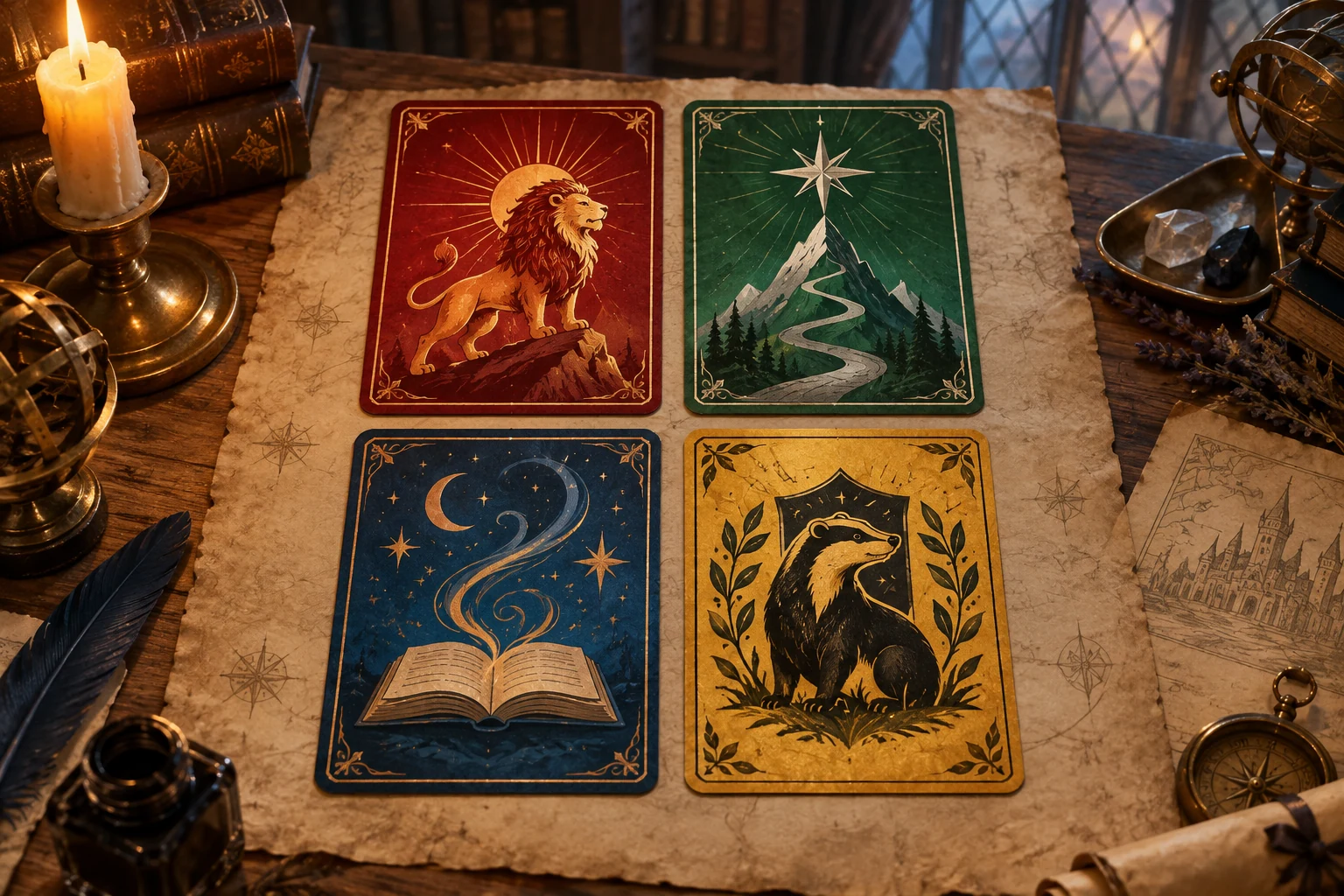
The Hogwarts groups are the four houses of Hogwarts School of Witchcraft and Wizardry. Each house is named after one of the school founders and is associated with a broad set of values. Gryffindor is usually linked with courage and nerve. Slytherin is linked with ambition and resourcefulness. Ravenclaw is linked with wisdom, learning, and wit. Hufflepuff is linked with loyalty, patience, fairness, and hard work.
In the story world, students are sorted when they arrive at school. The Sorting Hat considers personality, abilities, values, and sometimes preference. That last part matters for fans: the houses are not rigid personality boxes. They are narrative communities built around ideals. A person can be brave and clever, loyal and ambitious, curious and practical. The Sorting Hat tradition highlights the values that seem most defining, not every quality a person has.
For readers and fans, the groups work like a shared language. Saying "I am a Ravenclaw" often means "I identify with curiosity and independent thought." Saying "I am a Hufflepuff" may mean "I value fairness and steady loyalty." The houses are useful because they simplify identity into memorable symbols, but they should stay playful, flexible, and open to interpretation.
Hogwarts Houses Traits at a Glance
The fastest way to understand Hogwarts houses traits is to look at what each group celebrates when its qualities are healthy.
| Hogwarts group | Core traits | Healthy expression | Watch-out pattern |
|---|---|---|---|
| Gryffindor | Courage, daring, nerve | Speaking up, protecting others, acting when action is needed | Acting before thinking |
| Slytherin | Ambition, strategy, resourcefulness | Setting goals, adapting quickly, using influence wisely | Treating success as the only measure |
| Ravenclaw | Wisdom, creativity, learning | Asking better questions, enjoying ideas, solving puzzles | Overthinking or detaching |
| Hufflepuff | Loyalty, patience, fairness | Building trust, doing the work, including others | Avoiding conflict too long |
This is why a good house explanation should not reduce any group to a stereotype. Gryffindor is not only heroics. Slytherin is not only villains. Ravenclaw is not only grades. Hufflepuff is not only kindness. Each group has strengths that can become unbalanced when taken too far, which is exactly what makes house identity interesting for fans.
If you are comparing your own habits, pay attention to what motivates you rather than which label sounds coolest. Do you move first because action feels honest? Do you plan because influence and achievement matter? Do you analyze because truth and originality matter? Do you commit because fairness and trust matter? Those motivation questions are more useful than asking which house is "best."
House Animals, Colors, and Symbols
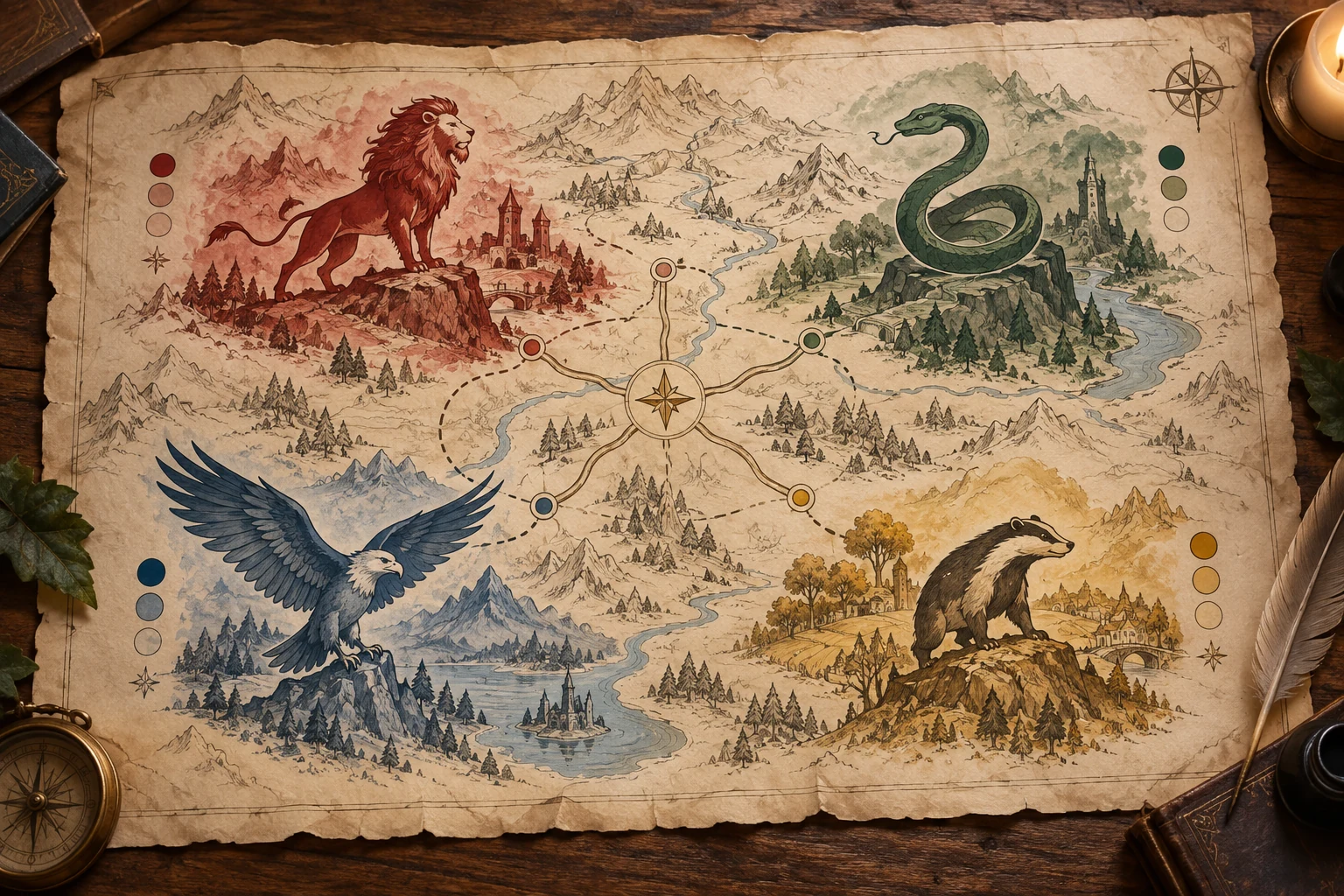
Hogwarts houses animals and colors make the groups easy to remember. Gryffindor is represented by the lion and by red and gold. Slytherin is represented by the serpent and by green and silver. Ravenclaw is commonly associated with the eagle in the books and with blue and bronze as its colors. Hufflepuff is represented by the badger and by yellow and black.
These symbols do more than decorate banners. A lion suggests bravery, pride, and presence. A serpent suggests strategy, patience, and survival. An eagle suggests perspective, height, and intellectual vision. A badger suggests steadiness, protection, and quiet strength. The colors reinforce the mood: Gryffindor feels fiery and bold, Slytherin cool and sharp, Ravenclaw airy and thoughtful, Hufflepuff earthy and warm.
For quiz users, symbols can be tempting shortcuts. You may love green and silver but still feel most at home with Hufflepuff values. You may admire the lion but live more like a Ravenclaw problem-solver. Treat the animals and colors as memorable entry points, not final evidence.
Hogwarts Houses Characters and Common Misreadings
Characters shape how fans understand the groups, but they can also distort the meaning of a house. Harry Potter is a famous Gryffindor, so Gryffindor often gets read as the heroic default. Draco Malfoy is a visible Slytherin, so Slytherin often gets unfairly flattened into cruelty. Hermione Granger is sorted into Gryffindor despite her intelligence, which is why people ask why she is not a Ravenclaw. Luna Lovegood helps many fans see Ravenclaw as creative and eccentric, not just academic. Cedric Diggory gives Hufflepuff a clearer image of fairness and integrity.
The key is that characters are examples, not definitions. Hermione shows that bravery and loyalty can be more central to a person than study habits. Harry's rejection of Slytherin shows that choice and self-understanding can influence identity. Slytherin characters also show ambition in different forms, from reputation-seeking to leadership to survival. Hufflepuff characters remind fans that quiet consistency can be as meaningful as dramatic heroism.
This is a useful place to use a house traits quiz experience as reflection rather than proof. A quiz can ask you to notice patterns in your decisions, but it cannot capture every contradiction in a person. The best result is one that gives you language for your values and invites you to think a little more carefully about them.
Harry Potter Houses Meaning Beyond Personality Labels
Harry Potter houses meaning is partly about personality, but it is also about belonging. A house gives students a common room, a team, a reputation, and a sense of tradition. That is why fans often talk about house pride. The group is not only "what you are like"; it is also "what kind of story you imagine yourself joining."
Gryffindor stories often center on moral courage, risk, and public action. Slytherin stories often center on power, legacy, strategy, and self-definition. Ravenclaw stories often center on learning, originality, and independent perspective. Hufflepuff stories often center on trust, fairness, service, and community. None of those stories is automatically better than the others. They answer different questions about what a person values under pressure.
The groups are also interesting because they overlap. A courageous Ravenclaw may challenge a bad idea with evidence. An ambitious Hufflepuff may build a career around helping people reliably. A loyal Slytherin may protect a close circle with fierce strategy. A curious Gryffindor may run toward danger because they need to know the truth. Hybrid readings are common because people are complex, and fandom identity is more fun when it allows nuance.
Hogwarts Groups Quiz Versus Hogwarts Legacy House Choice
A Hogwarts groups quiz and a Hogwarts Legacy house choice answer different needs. A quiz is usually built around personality, values, preferences, and imagined decisions. It asks, "Which group sounds most like you?" Hogwarts Legacy lets players choose a house inside a game experience, where common rooms, house atmosphere, and role-play style may matter as much as traits.
That difference explains why someone might get one quiz result and still choose another house in a game. If you love a common room design, want to role-play a different kind of student, or prefer a specific mood, that choice is valid for gameplay. A quiz result can support self-reflection, while a game choice can support story preference.
The same distinction applies to official and fan-made sorting experiences. Official Wizarding World content belongs to the official entertainment ecosystem. A fan-made site can offer a different kind of interactive reflection for fans, often with more flexible explanations and accessible entry points. When using any non-official quiz, keep the frame clear: it is for fun, fandom, and self-exploration, not canon certification.
How to Read Your Hogwarts Group Without Overthinking It
Start with values, then look at patterns. If you want a practical method, write down the four groups and answer three questions for each: Which trait do I admire most? Which trait do I actually practice? Which trait do I want to grow into? Your strongest answer may be your current house identity, while your aspirational answer may explain why another group appeals to you.
Next, separate aesthetics from behavior. Liking a house color, animal, or common-room mood is part of fandom fun, but it does not always match your decision style. Also separate stereotypes from values. A Slytherin result does not mean you are unkind. A Hufflepuff result does not mean you lack ambition. A Ravenclaw result does not mean you live only in books. A Gryffindor result does not mean you are reckless.
Finally, allow your answer to change with context. Many fans identify strongly with one house for years, while others discover that a different group fits them better as their priorities shift. That does not make the earlier answer wrong. It means house identity is a story you use to understand yourself, and stories can gain new chapters.
Choosing Your Hogwarts Group as a Fan
The most useful answer to "Which Hogwarts group am I?" is the one that helps you understand your values with a little more clarity. If you want a fast path, begin with the four value clusters: courage, ambition, wisdom, and loyalty. Then notice which one explains your decisions when things are difficult, not just which one sounds impressive.
For a more guided approach, you can explore your own house match and then read the result as a starting point. Ask where it feels accurate, where it misses something, and which secondary house also seems close. The goal is not to win the "right" group. The goal is to enjoy the Sorting Hat tradition while giving yourself a better vocabulary for the traits you admire, practice, and want to grow.
FAQ
What are the four Hogwarts groups?
The four Hogwarts groups are Gryffindor, Slytherin, Ravenclaw, and Hufflepuff. They are usually called houses. Each house has its own values, animal symbol, colors, common-room identity, and fan reputation.
Are Hogwarts groups the same as Hogwarts houses?
Yes. In most searches, "Hogwarts groups" means the Hogwarts houses. Fans may use "groups" when they are newer to the series or when they are looking for a quiz, traits list, or simple explanation of the sorting system.
What are the Hogwarts houses traits?
Gryffindor is associated with courage, daring, and nerve. Slytherin is associated with ambition, strategy, and resourcefulness. Ravenclaw is associated with wisdom, creativity, and learning. Hufflepuff is associated with loyalty, patience, fairness, and hard work.
Why is Hermione not a Ravenclaw?
Hermione has many Ravenclaw-like qualities, especially intelligence and love of learning. Her sorting makes more sense when you remember that Gryffindor values courage, nerve, and moral action. Her choices often show bravery and loyalty as central traits, not just academic strength.
Why did Harry not choose Slytherin?
Harry asked not to be placed in Slytherin because he associated it with people and values he did not want to follow at that moment. The scene is important because it shows that preference, self-knowledge, and choice can matter alongside natural traits.
What are the 28 wizarding families?
The "28 wizarding families" usually refers to the Sacred Twenty-Eight, a list of British wizarding families described in Harry Potter lore as supposedly pure-blood. It is a separate topic from Hogwarts groups, although some fans discuss it when talking about Slytherin, legacy, and wizarding society.
Is Ariana Grande a Slytherin?
Celebrity house claims are often informal unless the person has clearly shared a sorting result or fandom preference. It is better to treat celebrity house labels as fan discussion rather than official identity. The houses work best when you use them to reflect on values, not to verify public figures.